
11 ways the World Cup can help you survive
An adjustment to the Information-Action Ratio.

There’s a lot of stuff out there along the lines, “Can you guess the hidden meaning behind every World Cup kit?” and it’s hard to know how to feel about it.
On the one hand, it’s an eyesore and a regrettable reminder of how our brains have been turned to mush. On the other, there really is a lot to learn from a coming together of 48 rabid fanbases from the four corners and the Lord only knows how many nations, cultures and languages they represent. Your correspondent knows a straight shooter respected on all sides who will tell you without a hint of irony that this World Cup is the most important geopolitical event in history, and the thing it’s replacing at the top of the charts is the last one.
The 1001 plays it straight, of course, because you don’t need clickbait or SEO bros when huge-if-true claims like The World Cup is a random number generator and Everything is a tradeoff are, in fact, true. The thing about kit-based knowledge - and your correspondent says this as someone who, at the behest of Grandad, could once name the home ground of all 92 clubs in the Football League - is there’s very little you, someone in the waning days of their career with a laptop job, can do with it, other than score points at The Parrot’s Beak quiz on a cold, rainy Tuesday night in Sheffield.
The real quiz is extending as many careers and lives as possible long enough to see the next World Cup. For that, we need to adjust the Information-Action Ratio a little away from titillating trivia and toward generalizable concepts that can be deployed day in day out at the desk in mum and dad’s basement.
In no particular order, here’s a list of some of the things football commentators say which sound silly out of context yet will make you better at understanding workplace dynamics and communicating about them with your colleagues (human or otherwise):
1. Bottlejob
Your correspondent doesn’t make it easy for themselves. Got to start by explaining cockney rhyming slang. All the way back before Columbus set off the chain of events that led to PRESIDENT DONALD J. TRUMP, somebody winning the status game in rural England coined cockney as derogatory slang for somebody losing it in East London. In the 700 or so years since then, working class cockneys have been busy reclaiming the term and inventing a whole new language. Cockney rhyming slang uses normal English words to say normal things in a way unintelligible to anybody not appropriately educated. Apples and pears: stairs. Trouble and strife: wife. Bottle and glass: arse. Elite players use only the non-rhyming word, so going up apples, here comes trouble, and bottle end of nowhere.
To get from bottle to bottlejob, we layer on a heavy connotation of “shits himself under pressure”.
You do not want a bottlejob taking your penalties or pitching your product. What you want, when the chips are down on Sheffield Tuesdays, is somebody with minerals.
Play 5-a-side with your colleagues to find out who’s who.
2. Hairdryer (treatment)
This one is a lesson in how not to be a modern-day manager, from one of the greatest pre-modern managers. Sir Alex Ferguson led underdog Aberdeen to three Scottish League titles and a European Cup Winners’ Cup with the managerial philosophy of my way or the highway. He fined a player for overtaking him on a public road. Later, during the top dog stage of his career, he kicked a boot at David Beckham’s face.

Fergie didn’t invent yelling in players’ boat races with such vim and vigour that their barnet gets blasted back, but only he took it to such heights so often that his players needed a term of art to take the sting out of it.
If you catch any of your managerial colleagues giving an upstart the hairdryer, take them aside and remind them about a) cancel culture and b) Zinedine Zidane winning three straight Champions Leagues with the managerial philosophy of having good individual contributors and letting them do whatever the fuck they want.
3. Kill the game
Two-nil, they say, is the worst lead. (If you look at the stats, it’s probably not.) Rather than try to extend the lead, players and managers tend to twiddle their dials towards defending to protect it. This often results in using tactics that are less advantageous to themselves than those which earned the lead in the first place.
If the lead was lucked into rather than earned, or if there’s only a few minutes left, the calculus changes and you might want to park the bus. If you’re the better team with a two-goal first-half lead, don’t overthink it, just go score a third.
Which is to say, kill the game brown bread.
4. Mickey Mouse
To call a competition a Mickey Mouse competition is to call it uncompetitive, and to undermine any success anybody might have had in it. For example, “the move to 48 teams has turned the group stage into Mickey Mouse stuff, wake me up when we get to the knockouts.”
You need to be honest with yourself about whether and when you’re in a Mickey Mouse competition, to avoid getting high on your own supply.
5. Own goal
Football has its own special way of keeping you humble. In basketball, for example, players very rarely lob it in their own basket. In football, it doesn’t matter whether it’s Sunday league, a Mickey Mouse league, or the World Cup final, anybody could boot it in their own goal at any moment.
It’s all well and good saying don’t do stupid shit, but sometimes stupid shit just happens to you and there’s nothing you can do about it. The thing to do is accept it and move on without too much chuntering.
6. Parking the bus
Among etymologies, a personal favourite of your correspondent.
It was migrated into English football parlance by Jose Mourinho, self-anointed Special One and all-around ball buster, as a complaint about his opposition’s tactic of having every player stationed in deep defensive positions from the get go, akin to parking the team bus in front of their own goal and amounting to an unforgivable moral failing. Trouble was, Jose’s own tactical innovations all trended defensive, and so the great British football-watching public, who don’t brook much arrogance or hypocrisy at the best of times, let alone from a foreigner, threw it back in his boat with wanton abandon.
In the great global war for attention, remember being a memelord is a double-edged sword.
7. Professional foul
The Rules of the Game (an utterly arbitrary construct bequeathed to us by the random walk of history) determine which actions are valuable, and thereby which actions are incentivized. If the rules were different (sacrilege), then different actions would be valuable, and thereby different actions would be incentivized.
Sometimes, the computer in a player’s head runs the cost-benefit analysis and concludes that the winmaxxing play is to intentionally break the rules. The canonical example is hauling to the ground an opposing player in full flight towards a disheveled defence before he crosses into the range within which he or the referee can do any real damage. There are professionals who’ve built illustrious careers on the back of being able to avoid yellow cards by duping referees into believing their cynical acts of violence are good faith attempts to win the ball.
Those amateur gentlemen who hold themselves to a higher standard of probity are at a substantial disadvantage.
8. Showboat
Is what you’re doing actually making any goddam difference? Or are you just another showboat tricking yourself and others into believing you’re helping the cause?
9. Take a touch
Other than “ref!” and “fuckin-ell ref!”, this and “tiiime!” are surely the things yelled most often at 5-a-side. They’re both shorthand for “there’s nobody near you so when you receive this pass you’ve got time to take a touch, get the ball under control, get your head up, breathe, look around, assess the options, and then decide what to do next, rather than trying some fancy flick with your first touch that has never once worked in all the times you’ve ever tried it and inevitably leads to a counterattack going the other way because you are not repeat not Dennis Bergkamp for fuck sake!” (Meanwhile everybody on the other side is yelling “tiiight!”)
This is your correspondent’s favourite coaching point in the manual. When you receive an URGENT request via software engineered to make you want to respond immediately, take a touch. When you receive feedback it feels like your manager engineered in a lab to needle your ego, take a touch. When you receive the memo saying the tech team think they’ve only gone and grown superintelligence and asking should they ship it, take a touch.
10. Total Football
Total Football is the utopian dream, everybody’s skills broad and deep and all on the same wavelength, able to flow in and out of different roles within the same possession, covering all bases without ever leaving a gap. Real Total Football has never been tried, because people keep bumping up against everything being a tradeoff.
For as long as it’s composed of humans, your team is almost certainly not equipped to play Total Football. Play a left-back at left-back, and let the accountants do the accounts.
11. Zinedine Zidane
Before he was in charge of letting Real Madrid’s next-gen Galacticos do whatever the fuck they wanted, Zidane was one of the original Galacticos. It was in that formative stage of his life he became the poster child for many selves.
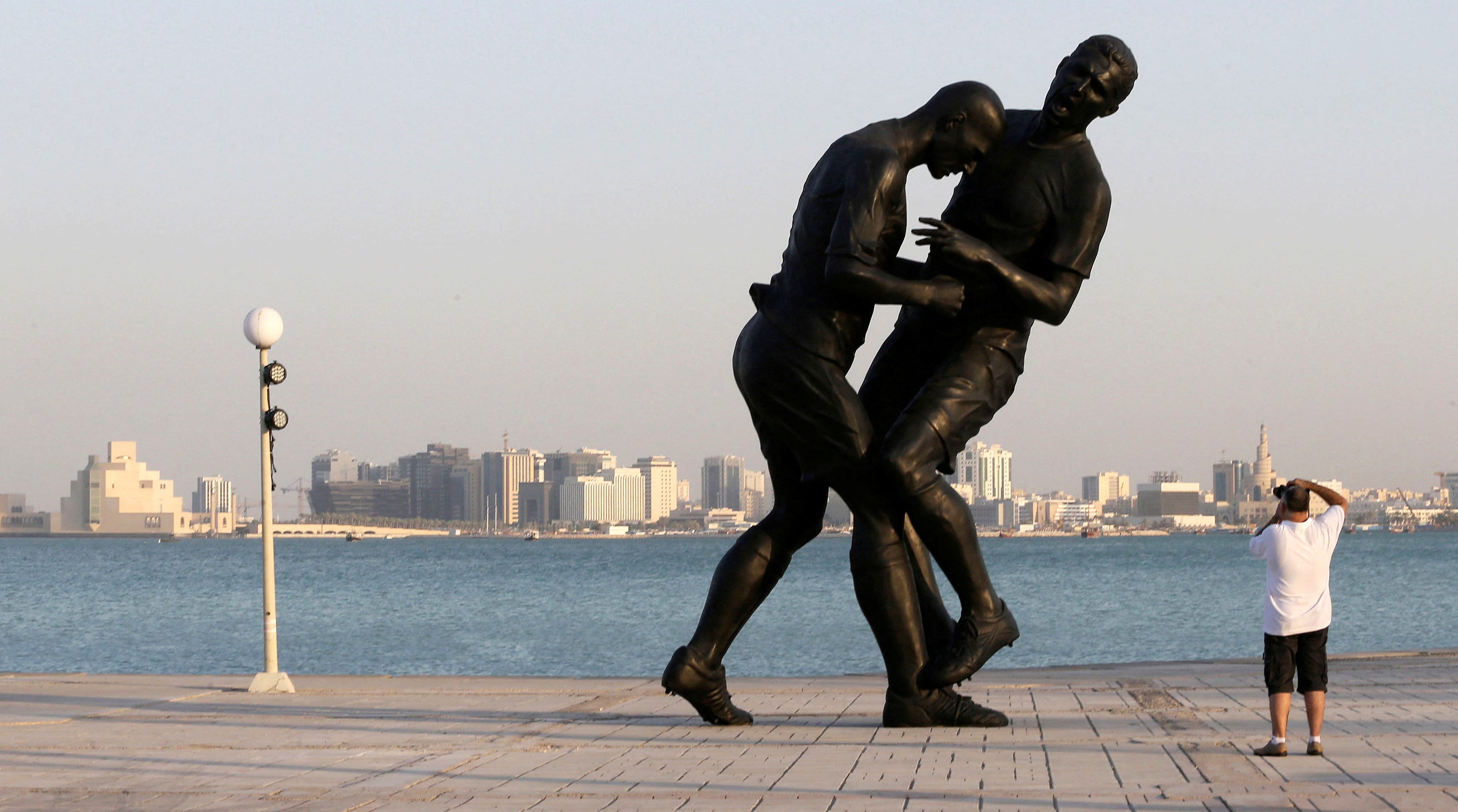
Of the many Zidanes, the pair that showed up for his World Cup final appearances were chalk and cheese. 1998 Zidane is the kind of guy who scores twice in Paris against Ronaldo’s Brazil to cement his place at the summit without batting an eyelid. 2006 Zidane is the kind of guy who raises the stakes by pre-announcing his retirement then wins player of the tournament leading France to the final where he scores their only goal, so far so good, and also the kind of guy who leaves as his indelible mark on the world an astonishing act of violence born of a failure to control his demons and done not only to Marco Materazzi but to his own team and to his better self.
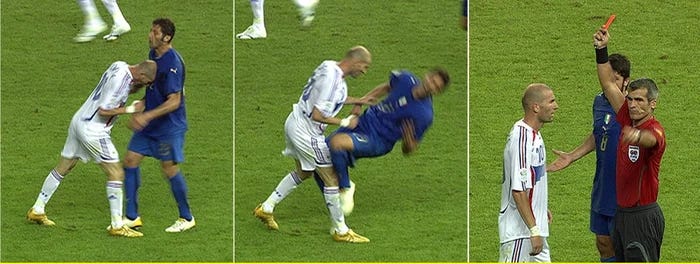
We are all Zidane. Our better selves are all at risk. Act accordingly.
Training data
📖Amusing Ourselves to Death (1985). Long before algorithmic feeds or AI, Neil Postman observed the televisual age and identified the skyrocketing ratio of total information to actionable information as an existential threat to our sense of agency and the societies built upon it.
🎵Through the Roses (2017). “It’s not easy, just being human / And the lights and the smoke and the screens / Don’t make it better / I’m no stronger than you and I’m scared.”1
📝Powerful A.I. Is Coming. We’re Not Ready. (2025). Take a touch.
Next play

Same playlist, ever growing
“…Just searching for truth.”
I didn't know that's where "bottle" comes from...!
Also, you forgot Aberdeen's 1983 European Super Cup!
And Zidane missed a couple of games earlier in 1998 for a needless red card...plus ca change