
Why isn’t there a shrine to the Unknown Donor at Roland-Garros?
Rafa Nadal isn’t the GOAT, and neither are Federer or Djokovic.

Shot: “Rafa gave absolutely everything. He gave us everything he had.”
Chaser: “I gave my life to one of the most individual sports that exists.”
Rafael Nadal changed my life. Granted, I believe every experience I’ve ever had changed my life in run-of-the-mill determinism ways. Nevertheless, if any athlete got in amongst my teenage neurons and muscled them about a bit, it was Rafa.
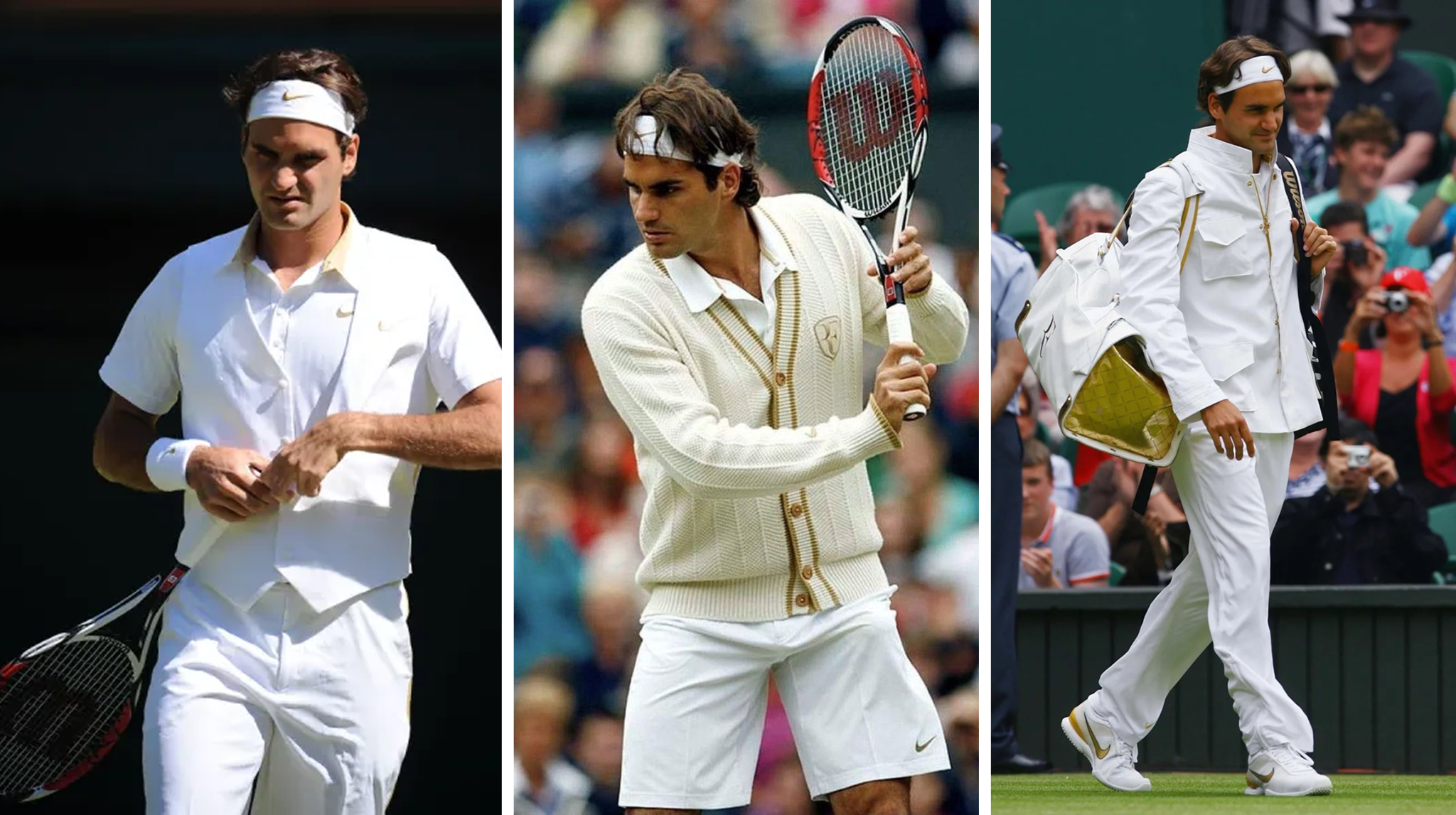
I wanted Rafa to beat Roger so bad. Nothing in particular against Roger, other than his sartorialism, and everybody fawning over him in spite of that.
Young Rafa was the perfect blend of undeniably elite and criminally under-rated, which I’ve come to realise is consistently my favourite combination, where you get to win and say I told you so. Steph Curry had this coming up against LeBron. Virat Kohli had it coming up against Australia. Mesut Ozil had it coming up against Arsenal fans.
In England, at least, mid-2000s Roger was unimpeachable because he won Wimbledon every year. Rafa winning the French Open every year starting with his very first attempt was considered, to the extent it was considered at all, not so much a black swan but a black sheep.
The thing was, though, that despite being written off as a mere clay court specialist, Rafa quickly got much closer to dethroning Roger in SW19 than Roger got at Roland-Garros. For all that Roger won on hard courts as well as grass, through impartial eyes it looked like Rafa was the one on a fast track to transcend the bounds of his natural habitat and emerge an all-court conqueror.
In 2006, Rafa won in 4 sets on clay, Roger won in 4 on grass. In 2007, Rafa won in 4 again on clay, then took Roger to 5 on grass. By 2008, Rafa had solved clay to such an extent that he didn’t drop a set the whole tournament and curb-stomped Roger in the final for the loss of four games.1 By the fourth set tie break of their third successive Wimbledon final, 18-year-old me was in Corfu celebrating the end of high school and ready to flip tables if anybody so much as breathed the word goat in Roger’s direction.
And then, as is so often the way, a doubt or two set in. Immediately after Rafa hit what would become a legendary running forehand to set up Championship point, Roger composed himself and defended his position at the pinnacle by hitting what I think is, to this day, the single best shot I’ve ever seen, better than in your life or the double bang.
Roger went on to win the breaker, two sets apiece, and then all the sun in Greece couldn’t stop it raining in London. The recently released Rafa documentary makes a multi-episode arc out of how the impressionable kid who believed Coach Toni was the rainmaker, rather than his uncle cosplaying a cross between Brando and JK Simmons without having understood either The Godfather or Whiplash as cautionary tales, became a real man when he realised he didn’t need a rain break to save him because he was Ready To Win. For me, at least, the waiting was the torture.
Enough people understood waiting till Monday to find out whose destiny was coming true would be intolerable that the fifth and final played out in Sunday’s gloom. At 7-7 things were getting silly. Then Rafa The Fighter, Rafa The Raging Bull, Rafa The Kid Whose Left Foot Didn’t Develop Properly Likely Because Of How Hard His Uncle Pushed Him When He Was Four Or Five Years Old And Played Through Pain His Entire Career, that Rafa, all those Rafas, found a way through.
It’s only by finding all sorts of ways through all sorts of things that you can win two Wimbledon titles on an unfamiliar surface, six more on unrelenting hard courts, and an unfathomable 14 titles with a 112-4 record at Roland-Garros.2
Rafa being belatedly recognised as a legend in his own lifetime led to one of the strangest sporting events of all time, on Court Philippe-Chatrier, a year ago, a year after his final appearance there as a mere mortal. I’ve seen my fair share of transcendent athletes retire, and done more than my fair share of eye-rolling at the hagiography. Yet it’s hard to overstate how bizarre this was.
First off, it was 47 minutes or 56 TikToks long, at a moment in history when bloggers the world over are struggling to meet the needs of their Very Online audience whose attention spans are barely one long sentence long.3
Second, Rafa’s rivals were at his side: Roger, Novak Djokovic, and Andy Murray (cute). Not crazy if you’ve been there throughout their decades-long grudging-respect-and-eventually-admiration-athon, but certainly not how these things typically go. Michael Jordan, to put it mildly, didn’t expect Magic Johnson or Karl Malone to show up at his parades.
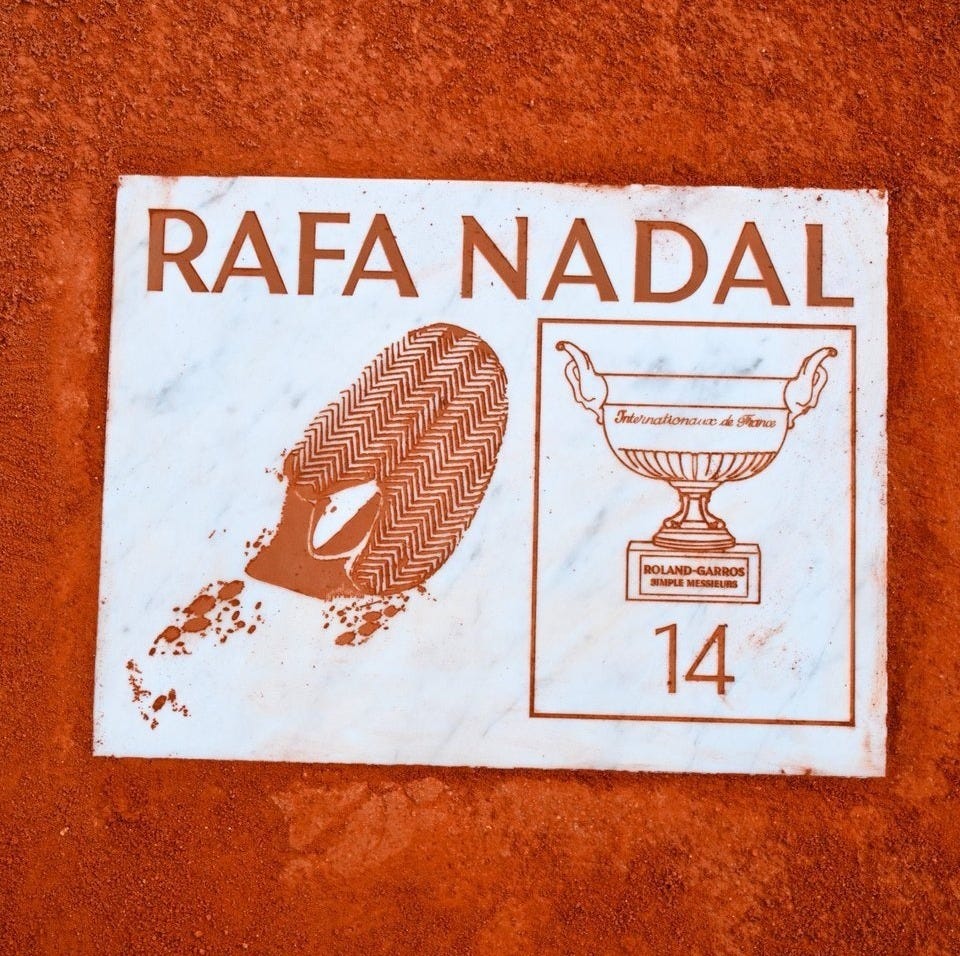
Third, and most disturbingly, it was presented, without a hint of irony, as a deification ceremony. Une pièce de résistance was the unveiling of a marble plaque that enshrines Rafa’s footprint in the clay of the court for all eternity. It was like the Planning Committee had given their algorithmic intern the prompt, “What if we held a funeral not only for Rafa The Righteous’s career, but for the demigod himself while he still walks among us? And what if we did it with truly American levels of earnestness without a hint of that European cynicism?”
Because here’s the thing. For all that I loved watching Rafa win and telling people I was right. For all that my little life was enriched by his willingness to sacrifice his lower limbs in the name of (his words) “exploring my limits”.4 For all that there are people doing active harm and still getting deified. For all that. This being the closest I’ve ever witnessed humanity come to agreeing what goodness - nay, greatness - looks like has to be a sign: we took a wrong turn some time around the year dot and never made our way back.
I wasn’t there when the Unknown Warrior was buried under Westminster Abbey. I wasn’t there on 20 July 1969, or on 8 May 1980, or on 9 November 1989. Maybe that the moon was landed and the smallpox eradicated and the wall toppled is evidence that we have been and could again be able to share in glimpses of higher goods.
The evidence I see every day is of people toiling in obscurity to solve the world’s most pressing problems, no less determined yet infinitely less feted than Rafa. Thousands of young children die every day from preventable diseases. Billions of animals live in torturous conditions on factory farms. Trillions of future moments as joyful as Rafa’s first Wimbledon depend on whether we safely navigate the transition to a world in which superhuman means something very different indeed.
So, dear editor, I hope this time you’re reading this isn’t one of the times it’s too late.
“I think he likes to suffer, with the intention of overcoming that suffering,” says one of Rafa’s team resignedly to camera.
There are some ways none of us can compete with Rafa. Vanishingly few of us will ever lie triumphant in the clay. There’s at least one way, though, we can all learn from his words, if not his actions.
“I’ve achieved my goal,” he sighs. “Which is to give my all, and reach my retirement in peace.” Pause. “With what my career has been.”
Out there are people just like us donating blood, organs, and 10% of their income to effective charities. Out there are people sacrificing blood, sweat and tears to pursue careers not crafted to overcome their own suffering, but to alleviate as much as possible the suffering of others who will never know their name.
One day, I hope, if we ever get our shit together, we’ll line up some of those people in a stadium and celebrate their heroism like there’s no tomorrow.
One of those people could be you.
Training data
🎵“Heroes” (1977). “I, I wish you could swim / Like the dolphins, like dolphins can swim.”5
📽️Raging Bull (1980). You can imagine how teenage me felt about a sports movie made by Scorsese and de Niro.
📖Determined (2024). Bearded Bob Sapolsky goes long on why none of us are the authors of our own destiny, and why it’s worth trying anyway.
📖80,000 Hours: How to Have a Fulfilling Career That Does Good (2026). Spend them wisely.
My counterfactual fantasy

According to the lamestream media, Mo Salah was merely an Egyptian king. Over here in Fantasyland, where everyman can pick his own poison and make his own name, Mo is our MVP, the Most Valuable Prophet.
Rafa won the French Open without losing a set four times over a fourteen year span: 2007, 2010, 2017, and 2020.
In one of the saddest moments of the documentary, a recently-retired Rafa pleads with his friends and family to agree that his 14 is a record likely to outlast Djokovic’s 24.
If you haven’t seen it, you don’t need to watch it all, just click through a few moments at random and see if it seems like an appropriately-calibrated social and cultural reaction to having played some admittedly epic tennis.
As Los Ultras will remember, I am not myself willing to sacrifice my lower limbs in service of the greater good. In the event I can’t flog another blog name, I’ll be going back to the bath of beans.
“...And I, I'll drink all the time.”