

You don’t have to stick to your picks
Changing your mind is not the second-worst thing you can do.

Success is a mess.
Doing hard things is hard. Mistakes will always be made, even by the best players. Bounces and breaks will always go the wrong way, even for the best teams.
We don’t know who will make which mistake, or when, or whether it will swing the outcome of a shot or game or a season. We don’t know which mistakes we’ll make, or when, or what effect they’ll have on the outcome of our day or our life or everybody’s lives.
The future is unknowable, and that was always true, even after the fact when the result suddenly feels like destiny. The world is way too messy to predict with certainty, and all we ever can do is try to figure out how likely different outcomes are. The world is way too messy to chart a perfect course, and all we ever are doing is turning little dials to try to make the chances of good things happening go up.
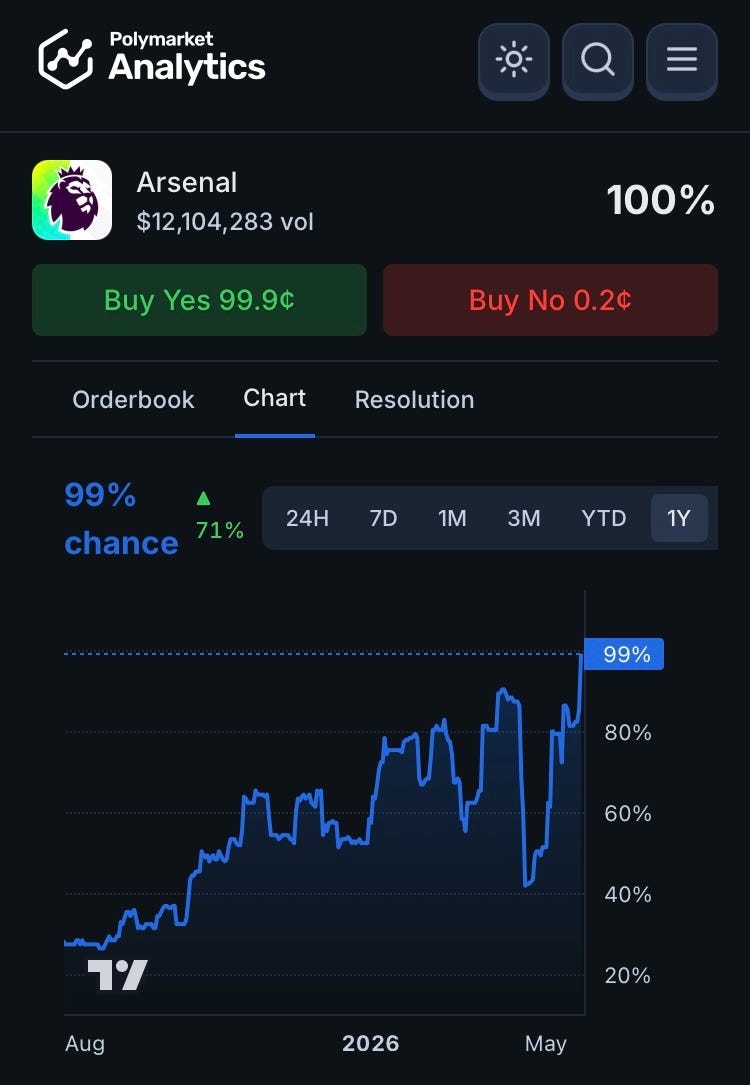
What a time it is to be alive. Good things are happening all over the sporting map. Not only the triumph of a Premier League team merely sponsored by a petrostate over a team actually owned by one, a shot in the eye for sportswashing if ever there was one, but in the same week an impossibly stupid Spygate scandal and the inexplicable return of the Special One, all situations engineered in a lab to keep bloggers in business.
And that’s before we turn our attention to the land of the free and the home of the brave.
The NBA Playoffs are where your attention should be if you want to see some of the best athletes in the world do insane things like be seven feet and four inches tall and toss a ball through a hoop from 32 feet away.
And the NBA Playoffs are where your attention should be if you want to hear some of the highest-paid pundits in the world say insane things like “I have to stick to my picks.”
No, you don’t. Changing your mind is not a sign of weakness. Sticking to your guns is not the opposite of spinelessness. Closing your eyes and hoping against hope you happened to be exactly right the first time, before the passage of time generated more information about who the contenders are and how likely each is to win and why than you can shake a stick at, is not a good way to be right.
The strength of the pull towards never admitting you were wrong shows up most bizarrely among analyst-pundits who spend countless hours going through the motions of breaking down hundreds of games and thousands of plays and writing about them and podding about what they wrote and tweeting about the pod, and then at the last declare they’re standing by their pre-season prediction “until proven otherwise”.
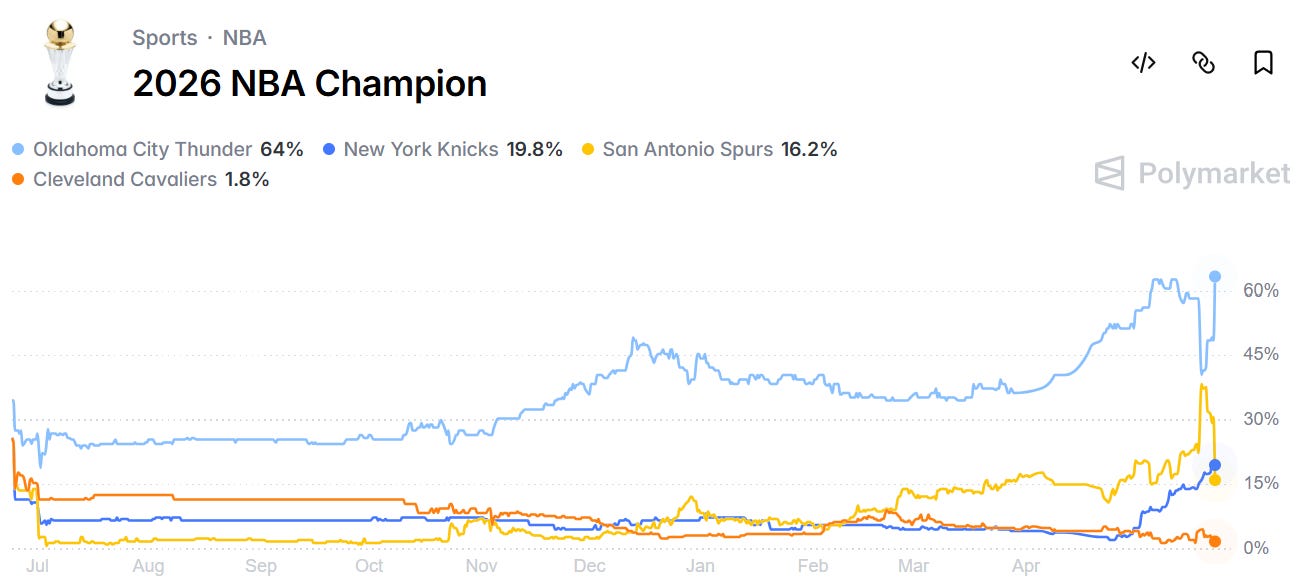
Now, it’s less likely you’ll be burned by a one-and-done prediction when your pick is a prohibitive favourite. This NBA season, people putting their money where their mouths are have in fact had the same favourite throughout. Yet the historically great Oklahoma City Thunder have been underdogs against the field until recently, and since the season started their likelihood of winning has ranged between 25% and 64%. The upstart Spurs got real close to overtaking them when Wemby had his out of body experience in the epic first game of the Western Conference Finals against OKC.
If you’re not yet convinced, take a look at the junior varsity:
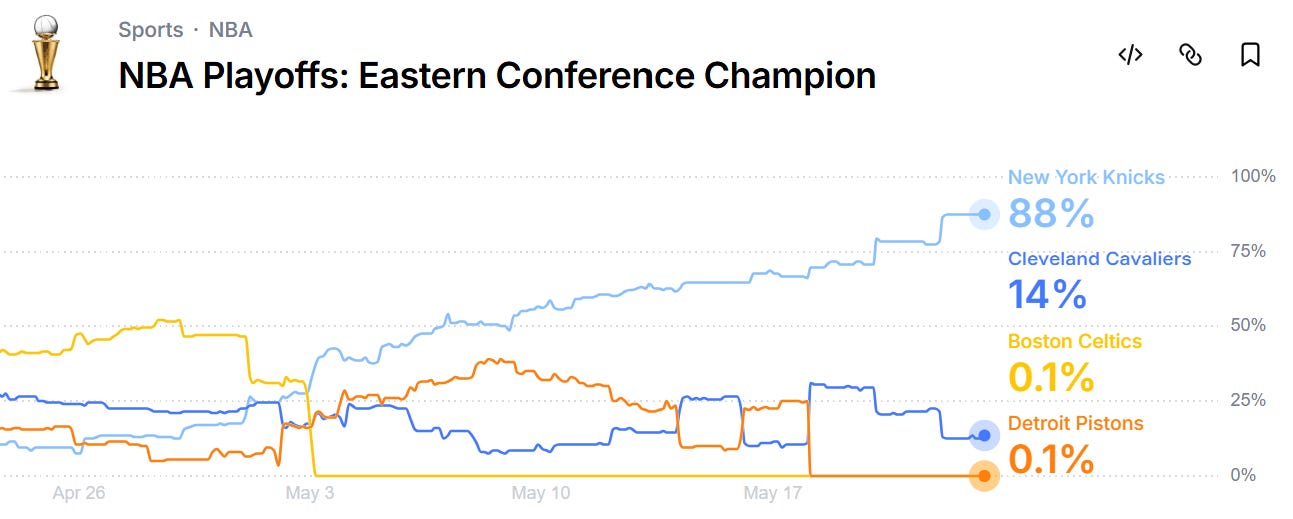
A month ago the New York Knickerbockers were fourth favourites. The favoured Celtics lost in the first round. The second-favoured Cavs had a ding-dong battle with the Pistons, who nobody in their right mind had predicted before the season would be the number 1 seed.
The aim of the prediction game is not to pick the winner every time. That’s an impossible goal, and impossible goals are bad. Things that seem unlikely according to the best available evidence happen all the time, and likely things fail to happen all the time. The aim is to assign an 88% probability to things that go on to happen 88% of the time. To be calibrated.
Calibration requires thinking in shades of grey. It requires a sliding number scale. And it requires sliding up and down the scale as a situation changes.
Changing your mind is not, on its own, the problem or the solution. If you’re already in the right place on the scale, stick. If you realise you’re wrong, twist.
Changing your mind can make you more right, and it’s an admission you were more wrong before. If you accept that we’re all just groping in the dark for probabilities we’ll never truly know, you can treat this as things working as they should, and reward people with praise when they make good faith attempts to be more right. If you cannot or will not accept that, if you use the conjuring words “U-turn” or “flip-flop”, you’ll inevitably treat mind-changes as problematic proofs of error.
People in positions of power often find themselves finding it hard to do hard things. They might realise the dials don’t work quite how they imagined from the outside. They might try to turn so many dials at once they can’t learn which ones do what. They might be whacked by unforeseen events that mean the dials they hoped to turn have been unplugged at the wall.
Penalising people with criticism when they make good faith attempts to be more right, to turn a new dial when the old one isn’t working, incentivises (in the best case) insisting you’re right even after you realise you were wrong, or (in the worst case) not trying to find out whether you might be wrong in the first place. These cultural dynamics reinforce our own worst instincts, stacking on top of our biased little brains already being geared towards defending ourselves and our ideas.
My favourite example of this dynamic came from the New York Times:

There is no attempt, in the headline or in the article, to adjudicate whether the PM was more right when he was flipping or when he flopped, or whether changing course was an appropriate response to a changing situation. (I didn’t know going in, and I was none the wiser coming out.) It’s simply treated as self-evident that “U-turns” are Bad. Where this breaks into classic territory is with the insinuation that the only thing worse for a politician’s prospects than the stain of having changed their mind is the stain of paedophilia.
The Thunder and the Spurs are embroiled in a classic series. The coaches are changing their plans of attack and defense not just every game but every quarter. Every possession, the players are learning more about how the dials at their disposal work in this match-up, only for somebody on the other side to tweak one of their own dials which changes what all the other dials do.
If anybody involved treated changing their mind as the second-worst thing they could do, their prospects would be dead on arrival.
Training data
🎵All These Things That I’ve Done (2004). “I got soul but I’m not a soldier.”
📖Superforecasting (2015). Philip Tetlock on the art and science of prediction.
📺Why “scout mindset” is crucial to good judgment (2016). Julia Galef on why it’s better to be a scout searching for the truth than a soldier defending bad ideas.
📝We Haven’t Seen the Worst of What Gambling and Prediction Markets Will Do to America (2026). Derek Thompson on the turn things have taken, and why we can’t have nice things.
Everything is a tradeoff

It’s not just that football is like a short blanket, as the goatee-toting manager Rafa Benitez was famous for saying, always forcing hard tradeoffs between covering space in attack and defence like a sad camper choosing between a cold head and cold feet. “Real life” is this way too.
Interesting read, I think the difference between the players and the pundits is only one is really incentivised to be right. One of the best things about the best of 7 format in the NBA is watching how the adjustments play out over time. While luck is still a huge factor, it does give the players and coaches a better chance to use their dials to good effect. All in the space of 1-2 weeks, winner takes all. How do the Knickerbockers stop L’extraterrestre?
On politics, have we not reached a stage where the dials aren’t effective enough and the populous too impatient (I blame Amazon Prime personally)? Many historically stable democracies are now being called ‘ungovernable’, including our own, as the endless feedback loop tells governments they aren’t up to it. Sadly, I don’t think the rest of the democratic system is incentivised to support the executive to be more right.