

LeBron James just got off the escalator to nowhere
The Decision, The Decider, The Desiderata.

Three frames for LeBron’s Last Decision coming up just as soon as I finish firing off my tweets…
“I’m not going for money.” – @KingJames
The Decision
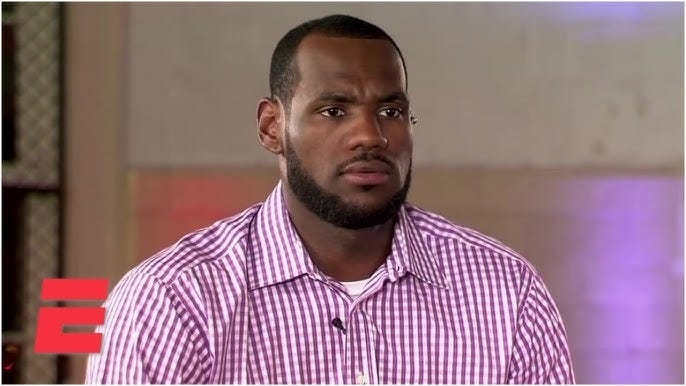
Do you remember 2010? It was seven years into LeBron’s NBA career (ongoing), and a bygone time when if you had something you wanted to say to the world, you booked a prime time slot on television, and everybody heard the same thing at the same time.
Appointment viewing, it was called. It was cool, really cool actually. You didn’t know what would happen, but you knew when it would happen, your friends knew when it would happen, and you could all plan around it: Mad Men Sunday night, blogs about Mad Men Monday morning, conversations about blogs about Mad Men Monday evening, clockwork. There was no requirement to stare at the screen all week in order to keep up, to be part of something larger than yourself.
2010 LeBron, the two-time reigning MVP and a free agent, took back control when he decided to announce his next team in a live ESPN special. The Decision was nobody’s idea of prestige TV. It was extremely cringe compared to Mad Men. People got bent out of shape about it: as if it wasn’t enough that the boy from Akron, Ohio might up and leave his home-state Cleveland Cavaliers (who he hadn’t chosen to play for in the first place, because the draft), he was brazenly rubbing his autonomy in their blue-collar faces. Nevertheless, “I’m going to take my talents to South Beach” was pure box office.
The Decision normalized self-determination in free agency, ushering in what’s now known as the player empowerment era. LeBron made the “Big Three” Heat (aka Heatles) possible by taking a trim compared to his maximum allowable salary (a thing in the NBA’s collective bargaining agreement), so Miami could simultaneously sign two other superstars under the salary cap. After he opted out of that contract in 2014 and I’m Coming Homed to Cleveland, he spent a decade promoting salarymaxxing as a core tenet of player empowerment, alongside signing shorter contracts enabling more frequent free agency. He set billionaire as an explicit goal.1
Thanks in part to his efforts, these days everything is cringe compared to The Decision. We’re all LeBron, or so YouTube, Instagram, TikTok would have us believe, our own little slices of life as a legend, with a different set of filters and dopamine for all. LinkedIn, Jesus, LinkedIn, every man and his dog announcing where they’re taking their less-than-generational talent.
2026 LeBron, by now a four-time champion and again a free agent, finds himself with a blockbuster Last Decision to announce. And…he just…he tweeted it out.

Twitter duly blew up. Although if you happened to not be on Twitter at that moment, or Instagram for the Meek Mill-soundtracked video version, you missed being part of it. And if you were tied to Twitter, or Instagram, throughout the first three weeks of free agency waiting for that moment, you likely suffered for it, what with all the amoral slop, predatory grifting and literal Nazism polluting your attention, which didn’t happen as much on ESPN.
The new way is way worse.
TV was far from a perfect technology (no such thing; everything’s a tradeoff). The only book I’ve put in the training data twice so far is Amusing Ourselves to Death, Neil Postman’s mid-80s diagnosis of how TV broke public discourse.2 The power of that book today, though, is how prescient its model of media was. The problem, we can now see, wasn’t television. It was the transition away from the written word to a visual medium, the overriding of principled (albeit imperfect) curators in favour of what we now call engagement, the replacement of evidence-based reporting with entertaining reactions. Applying those same dynamics maximally to everything everywhere all at once earned us nobodies a click here and there, at the cost of the rank degradation of the information-action ratio. With an outside view, outside our bias born of lived experience, it was predictable and predicted that being subjected to a constant stream of emotive updates about things beyond our control would lead to alienation and misery.
The 1001 is founded on the thesis that with better information we can take better actions. The world being more complex than we can comprehend means we need models of the past to understand the present, and models of the present to predict the future. Sport is among the last appointment viewings, and among the best predictive models.
The Decider
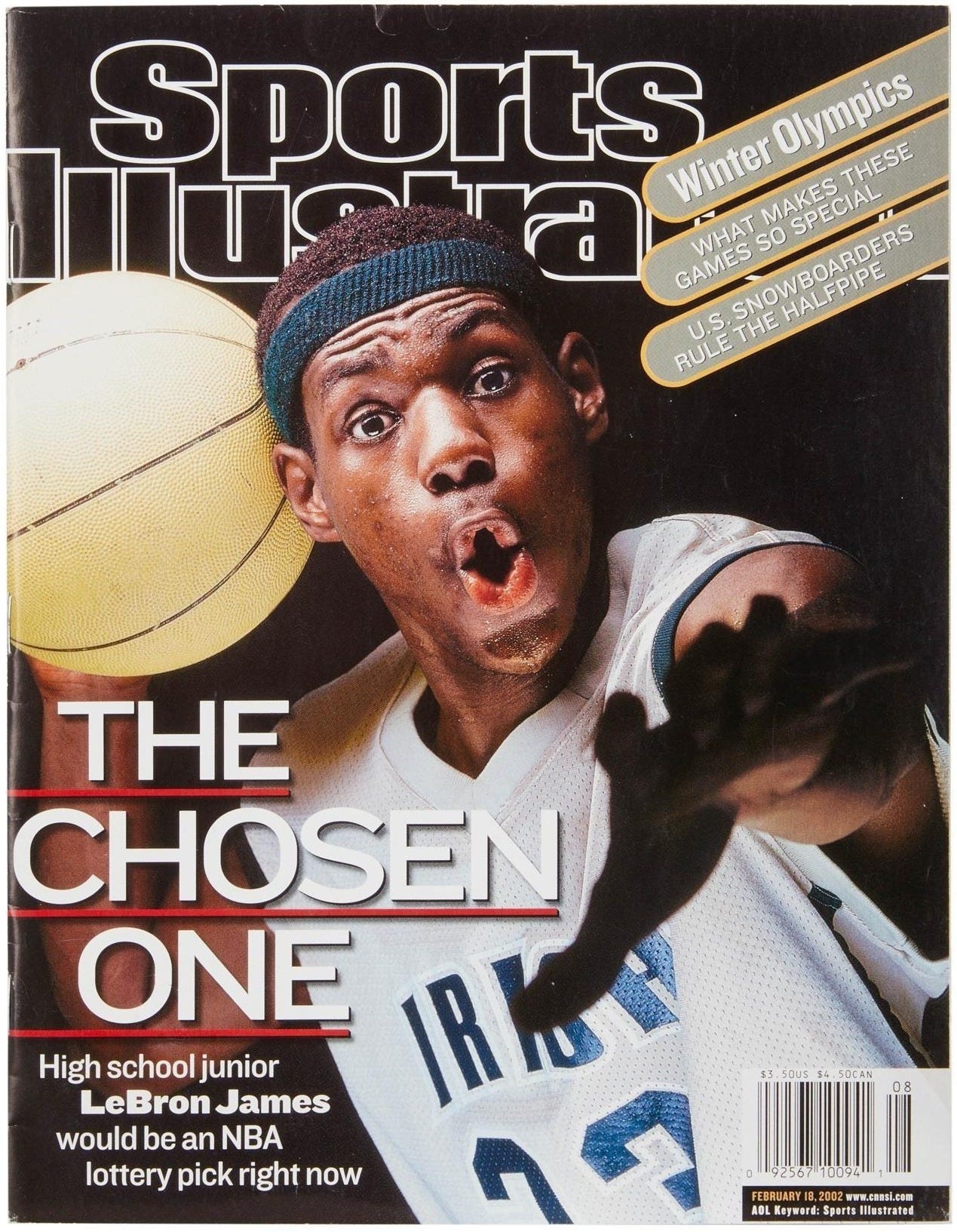
LeBron knows a thing or two about predictions, having come to prominence, on the cover of a magazine, as a schoolboy, under the pre-clickbait headline THE CHOSEN ONE.
He’s made it his business to live up to that prediction by defying countless others. You weren’t supposed to be able to score 25 straight points on the road in a double-overtime playoff game. You weren’t supposed to be able to come back from 3-1 down in the Finals. You weren’t supposed to be able to still move markets in a young man’s game at the age of 41.
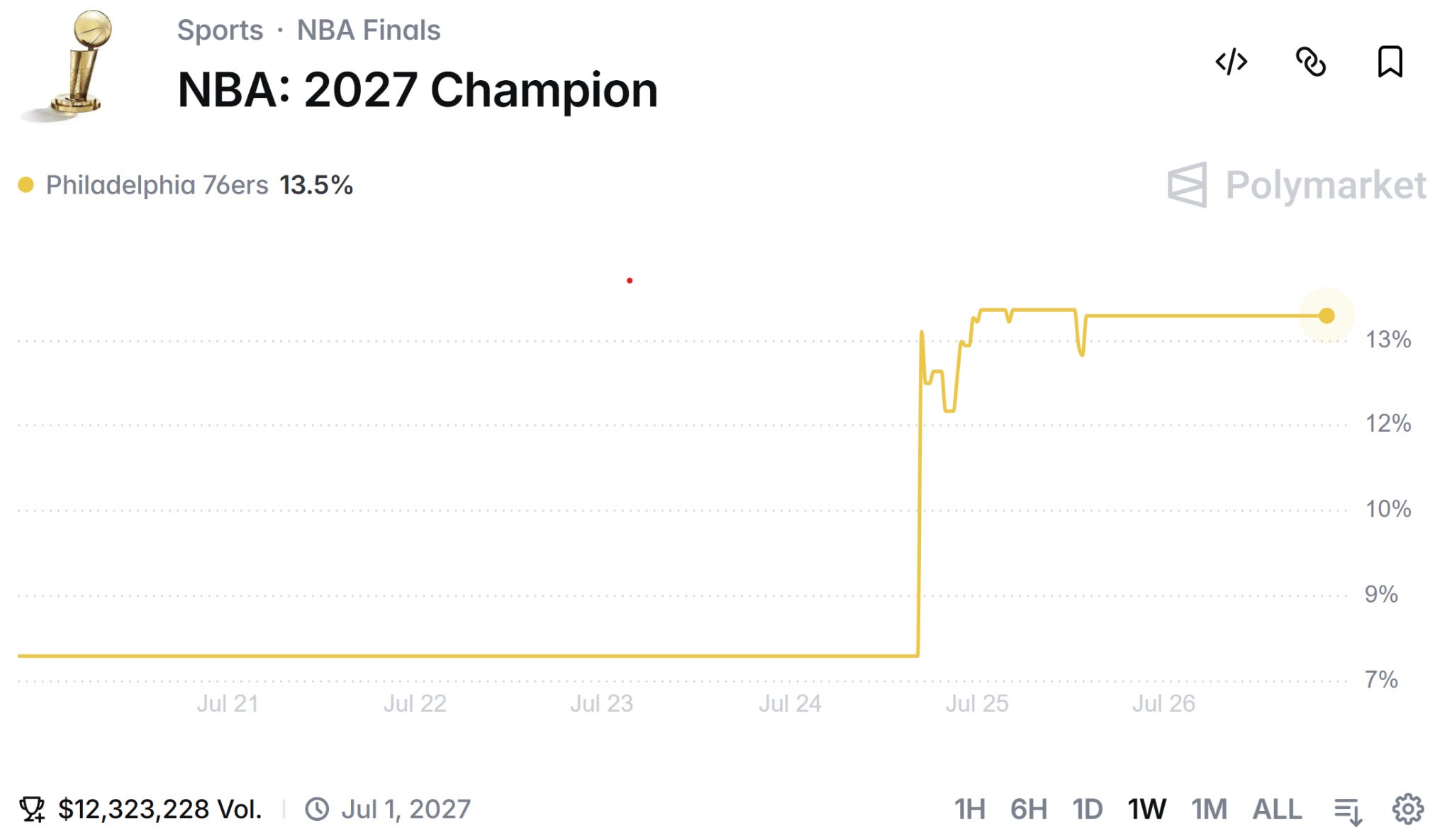
This is berserk.3
Age curves are one of the foundations of analytics: studies consistently show that basketballers (like soccerballers, etc) enter the pros as teenage liabilities, improve through their early 20s, peak in their mid-20s, decline into their 30s, and fall off a cliff in their mid-30s, if they even make it that far.
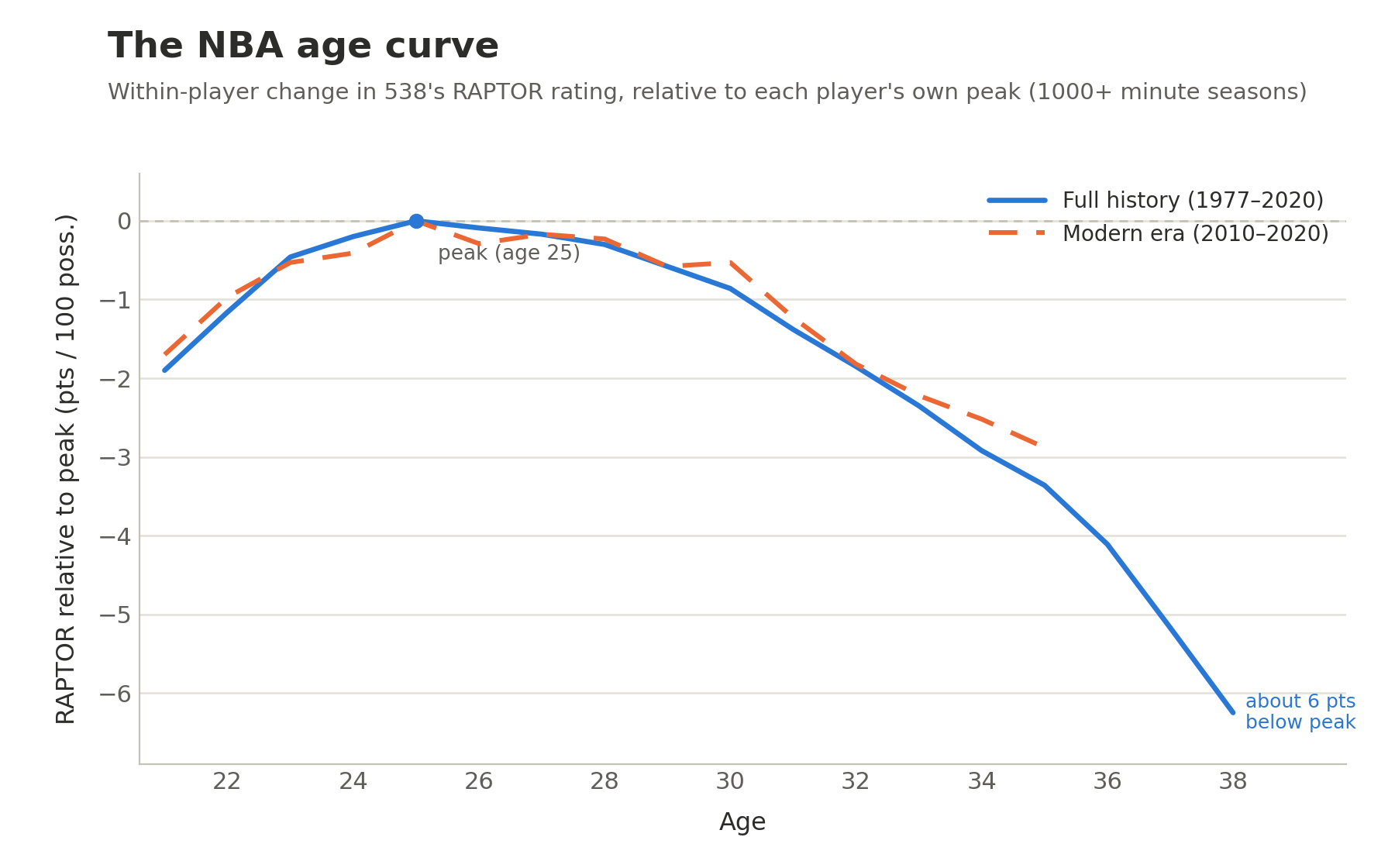
The decision-makers who first trusted their numbers guys made a killing cashing in their post-prime stars and picking up pre-prime prospects on the cheap, while dinosaurs kept getting the short end of the stick. Remarkably, decades into the Analytics Era, some front offices still haven’t caught on (looking at you, Sacramento Kings, Manchester United). Perhaps in part because of incomparables like LeBron and Messi, whose defiance of gravity tempts people who should know better into believing that maybe their aged star’s juice will still be worth the squeeze in the fourth year of an extortionate contract.
LeBron spent the first eight years after he turned 25 going to an unfathomable eight straight NBA Finals, four with the Heatles (two titles in 2012 and 2013) and four after going home to Cleveland (the most memorable title of all in 2016). He spent most of the next eight years being the best player ever at his age, and adding a fourth title with a third team (the Lakers in 2020).4
LeBron’s longevity is not explained by him being a modern man, it’s explained by him being LeBron. For all the good that spending seven figures a year on his body no doubt does, younger players benefit from sport science too. It’s wild that his decline has been slow enough that his physical cheat code is live and kicking: he’s still bigger than most young fast guys and still faster than most young big guys. And his genius-level pattern recognition and processing speed have shown few signs of dropping off.

Three months ago, 41-year-old LeBron was the best player on a team that won a playoff series, playing an inhuman 39 minutes per game for the Luka-less Lakers against the Rockets, one of the most athletic young teams in the league.
He took his sweet time toying with the idea of conceding to Father T. Then he decided he couldn’t leave impact on the table.
The Desiderata
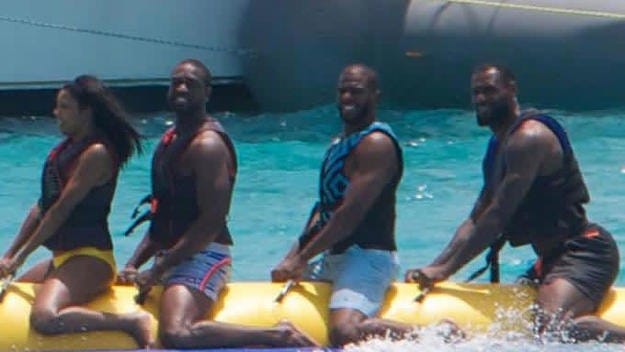
Why not go to the beach?
A cynic might say this is spin, obviously it’s money, it’s always the money. But that doesn’t come close to stacking up. Sure, $4 million is not nothing, but this is LeBron taking the minimum allowable salary, the only amount the Sixers were able to offer him from their salary cap straitjacket. While nobody in a capped-out league was offering him the max ($58 million), the more-fancied Cavs and Warriors went to great lengths unstraitjacketing themselves for a shot at paying him $15 million, almost four times the minimum. There’s no precedent for anybody so good to earn this little, or anybody so highly-paid to take such a drastic haircut.
A cynic might say, well, he hardly needs the money does he, what with having already achieved billionaire.5 Neither, though, do many of the people in various walks of life squeezing out every last dollar for the sake of it, every other axis of value and meaning be damned. Not least NBA players, not least previous iterations of LeBron.
The way our pecking orders are decided these days, being paid a relatively high salary affords psychic benefits. A relatively low one is an affront. Countless lives are spent on escalators to nowhere, pursuing the next promotion, the next bonus, the next mill, the next bill, in the vain hope there’s some threshold at which enough feels like enough.
It’s extremely cool to see somebody emerge from a culture which yokes together salary and status to do an about-turn and go all-in on anti-salarymaxxing. LeBron’s quest for empowerment is ending with the realization there’s more to life than money. He’s getting off the escalator. It’s going to be hard for the rest of us to replicate The Decider or The Decision, but this is an action we all can take.
Everything being a tradeoff means it’s rarely the case that salarymaxxing careers maxx much of anything aside from status symbols. In the NBA model, salarymaxxing trades against win probability: the salary cap means spending more on one player leaves less to spend on others; championship squads are built by extracting surplus value from underpaid players (like LeBron next season), especially superstar players worth more than the max (like LeBron for the last two decades).6
For the rest of us fortunate to be above the threshold at which our basic needs are met many times over, salarymaxxing typically trades against things like love, leisure and leaving the world better than we found it. If you’re acting like your top priority is upgrading your expensive holiday to an expensive holiday home, you’re on the escalator and you need to get off. There are dystopian novels much less disturbing than spending 16 caged hours a day moving other people’s money between screens to earn two weeks of summer in a chateau.
So much is made possible by moving outside the money frame. You’ll be spending something like 80,000 hours on your career, so it’s worth spending a minute thinking about what your goals are,7 for yourself and for the world, and deciding whether they’re better served on a new team.
Or by going to the beach.
Training data
🎵The Modern Age (2001). “Work hard and say it’s easy / Do it just to please me / Tomorrow will be different / So I’ll pretend I’m leaving.”8
📺Did LeBron James play the 3 greatest games ever in 2016? (2020). Even, maybe especially, for those of us who wanted the 73-win Warriors to win their rematch with the Cavs, LeBron’s performance in games 5, 6 and 7 was hard to credit as anything other than superhuman.
📝The third wave of American philanthropy (2026). In the age of AI, leaving the world better than you found it hardly requires you to live below the breadline. Far from it.
Next play
Why isn’t there a shrine to the Unknown Donor at Roland-Garros?

Shot: “Rafa gave absolutely everything. He gave us everything he had.”
Same playlist, ever growing
It’ll never not be funny that in the land of the free and the home of the brave, major league labour forces are ultra-unionised, every player subject to the collective bargaining agreement. Given the gameboard they play on, those unions do well for their members. The key fact about the gameboard, though, the key fact about the All-American sports marketplace, is that the rapacious rentiers who own the teams and thereby the leagues are also highly organized, into cartels. Those cartels secure astronomical returns for their members, windfall profits the likes of which the owners of soccerball clubs in laissez-faire Europe can only dream of, because a much higher proportion of their revenue goes to the players. In the NBA it’s ~50%. In the Premier League it’s ~70%.
I’ll let you decide whether that was intentional emphasis or imperfect record-keeping.
What price the 2027 news story, “LeBron acquaintance bet big on Sixers hours before Last Decision”?
Jordan was 35 when he retired for the second of three times, the one which marked the end of his era. (Not to be confused with the one when he went off to play minor league baseball instead, or the one that put an end to him wasting his dotage with the Wizards.)
Related goal, not yet achieved: owning an NBA team. He does own stakes in the Boston Red Sox and Liverpool, through his stake in Fenway Sports Group.
Victor Wembanyama, the best young prospect since LeBron, signed at a less drastic but maybe more precedent-setting discount earlier this summer. He could have signed a max contract extension worth up to 30% of the cap (conditional on hitting some achievable benchmarks next season); instead he settled for merely 25% ($252m over five years). Jalen Brunson, whose Knicks just beat Wemby’s Spurs in the Finals, signed at a discount a couple years ago. Both gave up a comparable amount to LeBron on an annual basis ($10-12m), albeit a smaller proportion and landing in a less shocking place; both also had the express intention of trading money for win probability, via better (paid) teammates.
If it’s AI-proof. If it’s not, spend a minute thinking about that as well.
“...So this is why I’m leaving.”